Maijishan Grottoes


  • maijishan grottoes
  • maijishan grottoes
  • maijishan grottoes
  • maijishan grottoes
  • maijishan grottoes
  • maijishan grottoes
  • maijishan grottoes
  • maijishan grottoes
  • maijishan grottoes
  • maijishan grottoes
  • maijishan grottoes

Maiji Mountain Grottoes are the fourth largest areas of Buddhist grottoes in China, after Magao Caves in Dunhuang, Yungang Grottoes in Datong and Longmen Grottoes in Luoyang.

Situated in the far North of China’s modern territory, the caves evolved throughout time, morphing with influence from new cultures and peoples. They continued to change over 12 dynasties, keeping a Buddhist thread throughout its evolution. Although this common theme exists, and the caves feature over 7,000 Buddhist statues, there is significant variation between the statues.

Many of the statues, especially those inside the caves are exquisite, and ornately decorated. These more elaborate statues were generally not created with indigenous stone, meaning the rock for these huge ornate statues was hauled up the mountain sides from somewhere else.

Strain as much as you like, but you will not find a satisfactory answer for every question the grottoes pose. Regardless, the beauty of these mysterious caves and carvings transcends beyond archeological mysteries.

Overiew

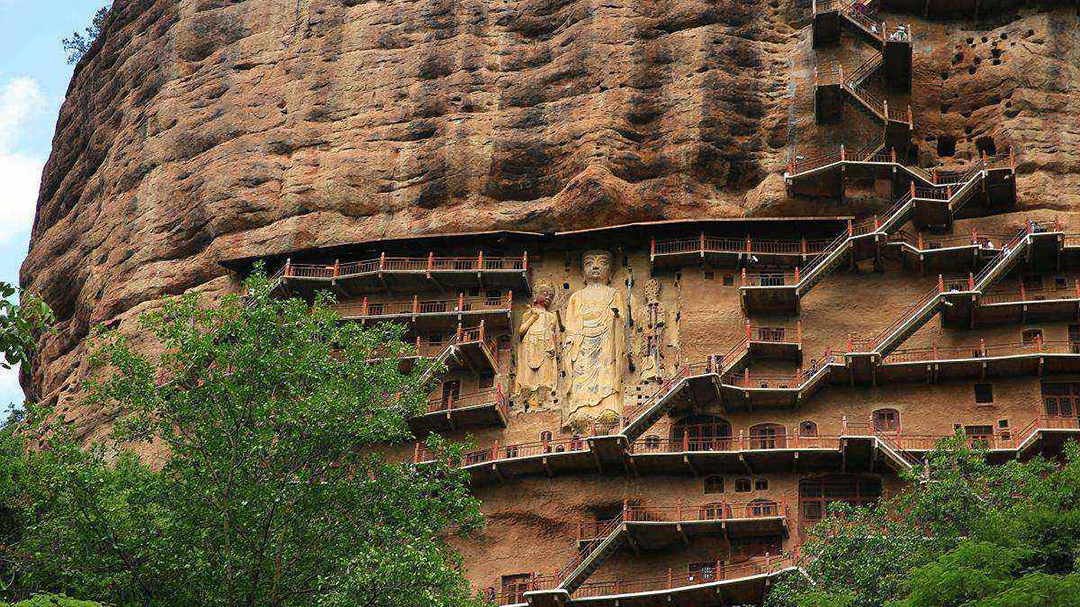
Maiji Mountain is 150 meters tall, and it was named for its shape - like that of a pile of wheat. According to historical records, the Maiji Grottoes were excavated during the Hou Qin Dynasty of the Sixteen Kingdom Period.

The Maiji Mountain Grottoes have a long history. Excavation and rock carving continued for more than a thousand years. During the Beizhou Dynasty, Liyunxin built the Seven-Buddha Pavilion in memory of his deceased father. Emperor Wen Di of the Sui Dynasty ordered the construction of a Buddhist nun site. The present dagoba on the top of the mountain was rebuilt in the Qing Dynasty. A lot of the original temples have been destroyed, but a lot remain. There are very old frescoes dating from before the Sui Dynasty.

History

In the area are preserved 194 grottoes of dynasties such as the Beiwei, Xiwei, Beizhou, Sui, and Tang, the Five Dynasties, Song, Yuan, Ming and Qing. There are 7000 clay sculptures and carved stone statues.

This grotto group, unlike the column-centered caves in the famous Mogao Grottoes, was built fully according to ancient Chinese tradition. Many fine statues, carved before the Sui Dynasty, are much more valuable than the statues in the Mogao Grottoes that were modified afterwards during several dynasties.

The artistic style in these grottoes show the influence of Central Asian cultures. The Maijishan Grottoes display the features of the culture of the Central Plains because its geographical position is near the Central Plains. The Yungang Grottoes, Sichuan Dazu Rock Carvings, Huangze Temple Caves and the Maijishan Grottoes impacted each other in style.

How to get

By Train:

1. Take a bullet train from  Lanzhou West Railway Station to Tianshui South Railway Station and it takes about 1h 20mins. Upon arrival, take bus 60 to Maijishan Tingche Chang (Parking lot of the scenic area).
2. Take a normal train from Lanzhou Railway Station to Tianshui Railway Station and it takes 4-5h. Then, take bus 34 to Maijishan Tingchechang.
 

By Bus:

Take a bus from Lanzhou Central Bus Station or East Bus Station to Tianshui and then take a taxi or local bus to the scenic area.

Entrance Fee May. - Oct.: CNY 90; Nov. - Apr.: CNY 70
Free for children under 1.2m (3.9 feet).
Opening Hours May - Oct.: 8:30 - 17:30
Nov. - Apr.: 9:00 - 17:00


Client’s Reviews

  • Maria P

    Maria P

    Reviewed 4thSeptember2016

    Really amazing. Very easy to find, from the train station, take n34 bus and get off at the last stop. The caves are 2km from the entrance, they offer you a Electric car, we didn't take it and it was like half an hour walking....More

  • gregsf11

    gregsf11

    Reviewed 6thOctober2012

    This is one of China's 3 major ancient Buddhist grottoes. It's every bit as ancient as the Yungang Grottoes, and I found it even more spectacular because of the setting, high up on a vertical cliff face, connected by a latticework of staircases attached to...More

  • TravelBugMalaysia

    TravelBugMalaysia

    Reviewed 23rdNovember2015

    Wow, amazing architecture, hundreds of staircase built onto the side of the mountain all the way up to the caves above. Giddy heights. Spectacular views

  • Edith B

    Edith B

    Reviewed 5thJune2017

    Maijishan is an absolutely amazing place, with magnificent stone carvings, beautiful frescos. The surroundings are also just beautiful. It is a pity though (but probably necessary) that many of the caves have metal screens for protection. You see through, but some details are lost. The...More

  • Russ J

    Russ J

    Reviewed 11thJuly2016

    This is one of the primary destinations of a tour of the silk road. it is one of the four famous grotto sites in China. You are immersed in 2000 year old and well preserved architecture of Buddhist caves with artwork. Built into the side...More

  • SoloWanderer71

    SoloWanderer71

    Reviewed 12thJanuary2014

    I was blown away. These caves are fantastic. The paint is in beautiful condition, and so bright. The downer was that there are thick screens over most of the caves, so it is difficult to view and take photos. I did see some folks that...More

  • TanSuo T

    TanSuo T

    Reviewed 4thMay2019

    I have been there twice, however, the first time we couldn’t get on the hill because of the heavy rain we got the day before. So it is better to call before coming. Usually they will not allow people to climb the hill after the...More

  • c8888

    c8888

    Reviewed 18thJune2016

    One of the four famous grottoes in China (the others being Longmen, Magao and Yungang). It's difficult to make comparisons between them all but there is a sense of grandeur to the Maijishan as you approach and progress through it via the walkways. Bus 34...More

  • enricocortez

    enricocortez

    Reviewed 8thNovember2015

    For me this made a stopover in Tianshui (an otherwise uninspiring place) very worthwhile. A spectacular setting and well preserved sculptures and some frescoes. Much better than the comparable Silk Road site, Mati Si, in my opinion. Very few tourists there on the Sunday we...More

  • Stay129949

    Stay129949

    Reviewed 25thSeptember2016

    Only 1h away from Tianshui railway station by bus n34 (5 yuan), it's located in a very pleasant park. The color of the autumn leaves will add extra beauty to the natural setting. The bus will leave you at the entrance. Just walk some steps...More

Top Attractions in Tianshui